National Love as a Personal and Social Experience
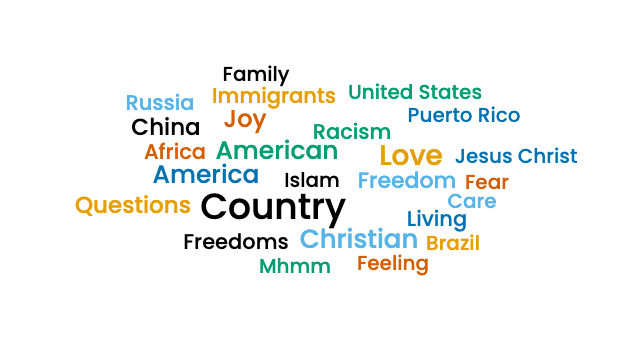
Across these interviews, participants responded to the question of whether they feel “loved by their country” in very different ways depending on their social position, background, age, and relationship to the nation. Rather than producing one shared definition of national love, the interviews show that different groups understand love through the specific needs, memories, and concerns that shape their lives. For some long-term American residents, feeling loved by the country is connected to freedom, choice, patriotism, and representation. For immigrants or people with transnational backgrounds, love is more often connected to welcome, practical support, safety, and community belonging. For younger people and international students, the idea of national love is tied to future opportunities, policy protection, and whether the country considers the needs of people at different life stages.
Table of Content
International Student
“I just hope to be treated equally.”
Immigrants and Transnational Belonging
“Respect is the word.”
For immigrants and transnational participants, national love was often described through respect, belonging, and everyday human connection rather than through government alone. Their answers suggest that feeling loved by a country is not only about official policies, but also about how people are treated in daily life: by coworkers, neighbors, communities, and strangers. Love becomes something practical and relational. It appears that people feel welcomed, recognized, protected, and allowed to belong.
The Brazilian immigrant’s story shows the tension between personal attachment and institutional uncertainty. He described the stress of applying for a green card while immigration policies and procedures felt unstable. Even after becoming a permanent resident, he still felt anxiety because of stories about green card holders being deported or prevented from reentering the country. For him and his immigrant community, travel, visa renewal, and even social media expression became sources of caution. This shows that belonging is fragile when legal status feels uncertain. Even when someone has built a life in the United States, fear can still shape how free they feel to move, speak, or participate.
“Respect is the word.”
This quote captures one of the clearest definitions of national love in this group. The Brazilian participant did not ask for dramatic recognition. Instead, he said that feeling loved would mean being respected and having immigrants’ contributions acknowledged. He pointed out that the United States was built by immigrants, yet some people now frame immigrants as taking someone else’s place. For him, a loving country would not spread hostility toward immigrants. It would recognize that immigrants help keep the country running and allow them to feel that they belong.
Other participants described love through community and daily experience. One participant with an African background said he felt loved because he had lived in Watertown for over twenty years and felt love from coworkers and people around him. At the same time, he expressed concern about immigration targeting based on appearance. This shows an important tension: a person can feel accepted in their immediate community while still worrying about broader systems that judge people by how they look.
The Puerto Rican participant offered another view of belonging. For her, love was connected to culture, warmth, and emotional recognition. She described arriving in Puerto Rico and hearing people clap when the plane landed, a moment that made her feel at home. Compared with that, she described the United States as colder and less personal. Her response shows that national love can also be felt through cultural gestures, shared emotion, and the feeling of being recognized by others.
Together, these stories show that immigrant and transnational participants understand national love as both personal and institutional. They may feel loved by coworkers, family, culture, or community, while still feeling vulnerable to immigration policy, discrimination, or social exclusion. For them, a loving country is not only one that grants legal status. It is one that treats people with respect, recognizes their presence, and makes belonging feel possible.
Older Local Residents
“You don’t have Choices.”
For older local residents, the idea of being loved by a country was often connected to freedom, choice, responsibility, and memories of an earlier version of America. Unlike international students, who often focused on immigration policies and future uncertainty, many older residents spoke through comparison. They described the country not only as it is now, but also as they remember it from decades ago. In their responses, national love often appeared as something that used to feel stronger, but has now become harder to recognize.
One repeated theme was the feeling that people no longer have the same freedom or choices they once had. One participant said very directly that the country does not feel loving because “you don’t have choices.” This quote is powerful because it shows how national love is understood as agency. To this participant, feeling loved by a country means having the freedom to make decisions, live safely, and guide one’s own life. She connected this loss of choice to larger concerns about wars, young people, gun violence, and the direction of the country. Her response suggests that love from a country is not only about emotional support, but also about whether citizens feel that their lives are still shaped by freedom rather than fear or restriction.
“You don’t have choices.”
Other older residents connected national love to responsibility and self-reliance. One participant emphasized the American Dream, hard work, religious values, and the importance of earning one’s place in society. For this person, loving the country required honesty, responsibility, freedom of speech, and respect for the Bill of Rights. Their understanding of national love was tied to the belief that people should work hard, learn the country’s customs, and contribute to society. In this view, love is connected to being represented by the government, but also to personal responsibility.
Another participant described love of country through patriotism, civic education, and the Constitution. She felt strongly that younger generations are not being taught enough about American history and civics. For her, feeling loved by the country was tied to flags, parades, public service, and the sense of honor that came from belonging to the nation. At the same time, she felt saddened by political division and believed that the country needed to return to the Constitution and a stronger sense of civic unity.
Together, these stories show that older local residents often define national love through memory and loss. They are not only asking whether the country loves them now; they are comparing the present to a past when they felt there was more freedom, respect, responsibility, and shared national identity. For them, a loving country would be one where people feel represented, where citizens have choices, where civic values are taught, and where freedom is protected. Their responses reveal a deep concern that the country has changed, and that loving the country now requires both remembering what it once meant and trying to recover what they feel has been lost.
Faith, Patriotism, and Responsibility
“If everybody is talking, then the odd one out is the one that pulls the gun out.”
Care, Safety, and Public Support
“As long as I am here, then you should take care of me.”
For some participants, national love means care, safety, and basic public support. Instead of defining love through patriotism or identity, they described it as whether a country protects the people who live there and helps them feel secure in daily life.
One participant explained that feeling loved by the United States would mean being treated equally, having basic protections, good facilities, and decisions that benefit everyone. Their answer shows that love from a country is not necessarily emotional. It can also mean responsibility.
“As long as I am here, then you should take care of me.”
This quote is important because it expands the idea of who deserves care. The participant does not limit national love to citizens only. Instead, they suggest that anyone living in a country should be included in its protection and support.
Other participants also connected love to safety. Some international students said they felt uncertain because of travel restrictions, visa concerns, or unsafe experiences. For them, safety was not only physical, but also emotional and social. They wanted to know that they could study, travel, work, and live without constant fear.
Together, these voices show that a loving country is one that makes people feel protected, included, and supported. National love, in this section, is not just a symbol. It is shown through equal treatment, public care, and the ability to live with dignity.
Across the Voices
Across these interviews, we came to understand that “being loved by a country” does not have one fixed meaning. Different people answered this question through their own life experiences, identities, fears, and hopes. For international students, national love often meant safety, stable policies, and equal opportunity. For immigrants and transnational participants, it was connected to respect, belonging, and everyday interactions with coworkers, neighbors, and communities. For older local residents, love was often tied to freedom, choice, responsibility, and memories of what they felt the country used to be. For others, love was expressed through faith, patriotism, care, or public support.
What stood out across the stories is that almost no one described national love as a simple feeling. Instead, participants explained love through concrete conditions: whether they feel safe, whether they are treated fairly, whether they have choices, whether their voices are heard, and whether they can imagine a future in the place where they live. This shows that love for a country is not only about pride or loyalty. It is also about whether a country creates the conditions for people to live with dignity.
We also noticed that many participants held mixed feelings. Some people loved their country but felt disappointed by its current direction. Some felt cared for by their local community but not fully protected by larger institutions. Some international students appreciated the education and opportunities in the United States while also feeling uncertain, unsafe, or unwelcome. These contradictions are important because they show that national love is complicated. People can feel grateful and afraid at the same time. They can belong to a place and still feel excluded by it.
Overall, these voices show that “loving our country” requires more than emotional attachment. It requires listening to people whose experiences are different from our own. It requires asking what safety, freedom, equality, and care actually look like in people’s daily lives. Across the interviews, we learned that a country feels loving when people feel seen, protected, respected, and able to build a future there. National love is not only something people give to a country; it is also something a country must show through how it treats the people who live within it.